Your great-grandparents heated with the fireplace because they didn’t have options. You have options — which means the open hearth can finally be judged on its merits, and the merits are mostly emotional. Here’s the honest comparison between the open fireplace your home came with and the wood-burning insert that turns the same chimney into an actual heating appliance.
The Numbers First
Efficiency in wood heating means one thing: the share of the fuel’s heat that ends up in your room instead of your flue or the atmosphere.
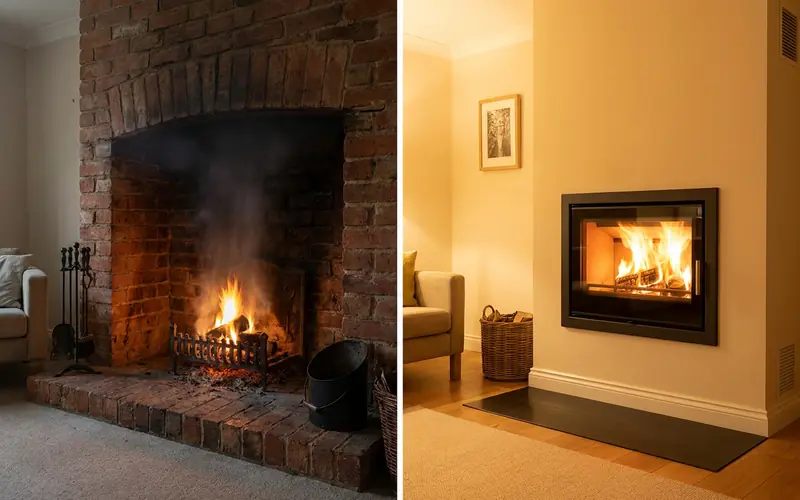
- Open fireplace: 10–15% on a good day, with a properly built fire and a warmed flue. Some of that “heat” you feel is actually radiation warming a circle around the hearth while the draft pulls heated air from the rest of the house up and out.
- Modern EPA-certified insert: 70%+ — sealed firebox, controlled combustion, and often a blower that actively pushes warm air into the room.
That five-fold difference compounds across an East Tennessee heating season: the same cords of firewood deliver five times the heat, or the same heat from a fifth of the wood and cost.
What an Insert Actually Is
An insert is a self-contained wood-burning appliance that slides into your existing masonry fireplace opening and seals against it: a steel or cast iron firebox with a glass door, an air-control system that meters combustion, and typically an optional blower. The chimney stays; the fire changes completely.
The installation detail that decides whether the appliance performs like the label promises: the flue liner. Inserts don’t vent into the full width of the old fireplace flue — they connect to a stainless liner sized to the insert. Venting into the big, cold, oversized flue undoes most of the efficiency gains (cooler exhaust, stalled draft, faster creosote). The liner isn’t an upsell; it’s the second half of the appliance. Full details on our relining page.
Open Hearth vs. Insert: What Changes in the Room
Heat
The category isn’t close. An insert heats the room — actually heats it, for hours, with the door closed and the draft controlled. The open hearth heats faces and a floor circle while it runs, then gives everything back when it dies.
The Fire Experience
Here’s where the honest trade lives. An open hearth is a show: crackle, sparks, the smell, the open view. An insert is a sealed glass fire — still lovely, still radiating, but a picture of fire rather than fire itself. Most insert owners stop noticing within a season; a few genuinely grieve the open hearth. Worth knowing yourself before choosing. (If you want both worlds, some families keep the open fireplace on the main level and add a stove or insert elsewhere — stove installs are their own option.)
Burn Time & Overnight Heat
Open hearth: out in an hour or two, room cooling by midnight. Insert: load at 10 p.m., coals at 6 a.m., relight without kindling. For families who heat with wood as a lifestyle, this is the difference between ambiance and appliance.
Smoke & Air Quality
Sealed combustion burns the smoke as fuel — inserts emit a fraction of the particulates of an open fire. Your living room stays clearer (sealed doors end the occasional smoky-evening problem), your neighborhood air is cleaner, and your annual sweep finds less to do.
Safety
Both systems are safe when maintained — the difference is failure mode. A sealed insert with a proper liner keeps sparks, embers, and rollovers behind glass; an open hearth asks you to manage them with screens and habit. Households with kids and pets tend to notice this one most.
What the Upgrade Actually Involves
Scope for a typical masonry fireplace in our service area: (1) a pre-install inspection to verify the firebox and chimney are sound; (2) the insert itself, sized to the opening and your heating goals; (3) the stainless liner, connected and sealed to the insert collar; (4) hearth extension where the listing requires it; (5) blower and a walkthrough. Typically a one-day install. The scope depends on the appliance and your chimney — we quote the complete, code-compliant install (appliance, liner, hearth, and all) in writing before anything is ordered. Details on our insert page.
One compatibility note we check every time: inserts fit masonry fireplaces. Zero-clearance (prefab metal) fireboxes usually can’t take listed inserts — if that’s your setup, we’ll tell you during the inspection and walk you through stove alternatives instead.
Which One Fits Your House?
Keep the open hearth if the fireplace is evenings-and-holidays theater and your heating is handled. Consider the insert if you’d rather your fireplace worked for a living — especially if you already buy firewood and your living room is the room that matters.
Want a read on your specific fireplace? That’s a free-quote conversation: request one here or call (865) 309-5432. We’ll measure, inspect, and tell you honestly what fits — including “your fireplace’s perfect as it is.”