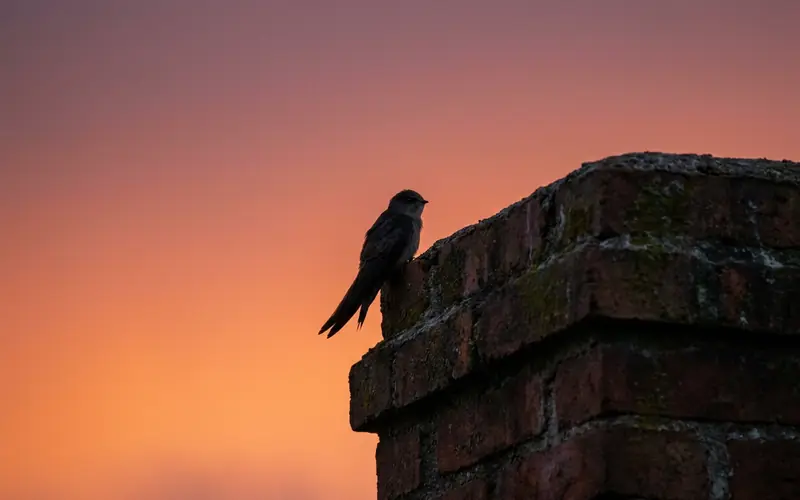
Every summer we get the same call from across East Tennessee: “There’s a bird in my chimney — it sounds like a rattlesnake / a machine / a UFO.” That chattering, almost mechanical twittering is the chimney swift — a dusky little bird that spends its life on the wing and its summers raising chicks inside… chimneys. They like yours.
Before anyone climbs a ladder: chimney swifts are protected under the federal Migratory Bird Treaty Act. That changes everything about what you’re allowed to do, and what we as a company are allowed to do for you.
Meet the Bird That Adopted Your Chimney
Chimney swifts can’t perch — their feet and tail are built for clinging to vertical surfaces, which is why they historically nested in hollow old-growth trees. East Tennessee’s forests no longer have many giant hollow trees, so the species adapted to the next best thing: our masonry chimneys. From roughly late March through early fall, swifts use uncapped, unlined or tile-lined chimneys across Knoxville, Maryville, the Tri-Cities, and everywhere in between as nesting habitat.
The pair builds a small half-cup nest of twigs stuck to the flue wall with their saliva (yes, really — it’s excellent adhesive), and both parents raise the brood. The racket homeowners hear is the feeding chatter of hungry chicks — loud, distinctive, and seasonal.
Why the Law Is the Law
Chimney swift populations have declined significantly over recent decades as old chimneys are capped, lined with smooth stainless (which swifts can’t cling to), or demolished. Because the species depends on a shrinking habitat, it — and its nests, eggs, and young — is protected. Removing, disturbing, or destroying an active nest is a federal violation carrying real penalties. It doesn’t matter that it’s your chimney; the birds and their active nests are protected while occupied.
We won’t remove an active swift nest, and neither should anyone else — any company offering to do it in nesting season is offering you both a dead bird problem and a legal one.
The Good News: The Timeline Handles Itself
Swifts are excellent tenants with a firm move-out date. The young fledge and the family departs by late summer or early September, heading to wintering grounds in the Amazon basin (a genuinely remarkable migration for a bird that weighs less than a golf ball).
Once the birds are gone — the chattering stops, and no adults are seen entering at dawn or dusk — the old nest is no longer legally protected, and the flue can be cleaned, inspected, and capped so next summer goes back to being quiet.
What to Do While They’re There
- Don’t light the fireplace. Not “be careful” — don’t. Smoke and heat in an occupied flue can kill the birds (illegally) and can also backdraft soot into your home.
- Enjoy it, honestly. They eat enormous quantities of mosquitoes and flying insects. A summer of swifts is a quieter, less bitten backyard.
- Schedule the service for fall. Sweep, inspection, and — this is the important part — a properly fitted cap.
The Permanent Fix: The Cap
Chimney swifts are only a “problem” while your flue is an open door. A professionally sized chimney cap closes that door — birds, squirrels, raccoons, rain, and debris all get turned away, and the flue dries out between burns. For swifts specifically, caps with the right mesh spacing also let the system vent correctly while excluding nesters.
The sequence we run for East Tennessee homeowners every fall: wait for departure → sweep the flue (removes the old nest and any debris) → Level 1 inspection → install the right cap. Done in one visit, and the following summer sounds like summer again.
A Note for Wildlife-Friendly Homeowners
Some homeowners — and we salute them — ask about leaving a chimney open for the swifts. If that’s you, the birding community can point you toward dedicated swift towers as an alternative habitat, and we’ll keep the chimney itself available in a way that’s safe for both the birds and your system. It’s your chimney; we’re glad to help you host tenants on purpose rather than by accident.
Hearing the chattering now? Book a fall sweep — we’ll schedule it after the birds leave, clean the flue, and cap it so next year is your call. Questions about birds, nests, or animals in your chimney? Call (865) 309-5432.