East Tennessee gets 50+ inches of rain a year, and every drop that hits your roof is looking for a way past your chimney. The chimney is the most complicated thing on most roofs — masonry, metal, concrete, and flashing all meeting at the worst possible place to have a seam — so it’s no surprise that “mystery water” near the chimney is one of our most common service calls.
Here are the five places water actually gets in, in the order we find them. (Full service details on our chimney leak repair page.)
1. Flashing (Where Chimney Meets Roof)
The #1 entry point, especially in the years after a roof replacement. Step flashing and counter flashing form the waterproof handshake between masonry and shingles; when corners lift, sealant fails, or a roofing crew’s details don’t quite reach, wind-driven rain enters at the joint — and runs down inside the attic, showing up as a stain nowhere near the actual gap.
The signature: stains that follow heavy, windy rain; water that appears only in certain storm directions.
The proper fix: layered metal flashing — step flashing, counter flashing set into the masonry — sealed with the right materials. Not a caulk bead from the hardware store: that’s a seasonal band-aid that traps moisture and fails within a year or two. If your leak traces to flashing, it’s worth checking the whole roofline-chimney seam — one failed corner usually has company.
2. The Crown (The Concrete Cap on Top)
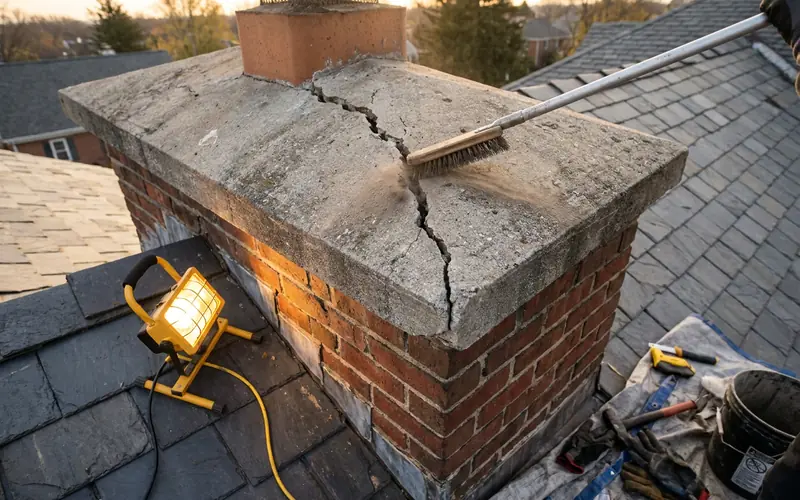
Your chimney’s crown is a concrete wash, and it lives the hardest life of any component on your roof: full sun, hard freezes, and 500°F flue gas cycling from inside. Crowns crack — hairline at first, then channels that pour water straight down the masonry’s core. The thin, unsloped crowns common on East Tennessee homes built during the region’s growth booms fail fastest of all.
The signature: leaks that follow any rain (wind not required); sandy mortar debris in the firebox; cracks visible from the yard with binoculars.
The proper fix: resurfacing or rebuilding the crown with real slope and expansion control — or a full crown-pour on rebuilds. Crown repair is among the best cost-to-consequence ratios in our trade: a few hundred dollars now prevents thousands in masonry damage later.
3. No Cap (Or a Failed One)
An uncapped flue is an open hole in the sky: rain falls straight down the chimney. Rusted-out caps drip rain through holes the mesh used to cover. The cap is also the only thing standing between your flue and every animal in the county looking for housing (nest material absorbs and holds water against your flue tiles for months).
The signature: water in the firebox or damp ash after rain; rust streaks down the stack; the obvious one — standing on the lawn and seeing no cap.
The proper fix: a stainless cap sized to the flue. For lakeside and ridge-top homes around Fort Loudoun, Tellico, and the Tri-Cities, we spec storm-rated stainless — the light-gauge versions don’t survive the exposure.
4. The Masonry Itself (Porous Brick & Open Joints)
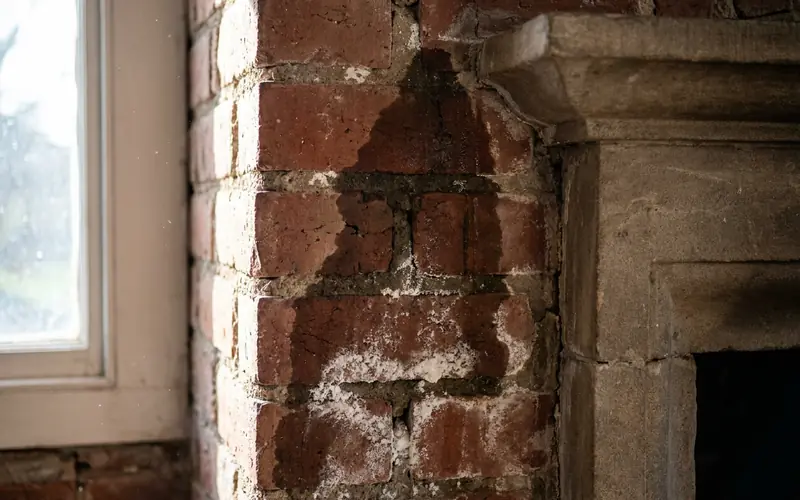
Brick and mortar are porous — that’s normal and fine when the wall can shed and dry. But receded mortar joints, spalling brick faces, and porous soft-fired brick (common in our region’s oldest homes) absorb wind-driven rain directly. Add East Tennessee’s freeze-thaw cycles — wet masonry freezing overnight, expanding, popping faces — and absorption becomes a self-accelerating problem.
The signature: white efflorescence (mineral staining) on the exterior; spalling brick faces; leaks that follow storms from specific directions.
The proper fix: tuckpointing open joints, replacing failed units, and then — the step most companies skip — a breathable silane/siloxane water repellent. “Breathable” is the whole point: it blocks liquid water while letting vapor escape. Never, ever let anyone paint your chimney with film-forming “waterproofing” — it traps moisture inside and destroys masonry from within. Full detail on our masonry repair page.
5. Condensation (The Sneaky One)
Not all chimney water comes from outside. Flue gases carry significant water vapor; when they cool too fast — oversized flues, cold exterior chimneys, cool-running appliances — that vapor condenses on the flue walls and runs back down, soaking the masonry from the inside. The signature: a sour smell, damp firebox, and moisture staining without any correlation to rain.
The proper fix: depends on the diagnosis — usually right-sizing the flue with a liner, insulating an exterior chimney, or adjusting how the appliance is being run. Condensation is the one cause on this list that a camera inspection really earns its keep on.
How a Leak Trace Actually Works
The stain is where water ended. The entry is somewhere else — above it, sideways from it, sometimes two floors from it. That’s why we never quote a leak repair blind: we trace it first — roof inspection, targeted water testing, camera scan as needed — find the actual entry, and then quote the fix. Homeowners are regularly relieved to learn the scary-sounding problem is a minor crown seal — we confirm the exact scope in writing before any work begins.
Seeing water where it shouldn’t be? See our leak repair service or call (865) 309-5432 — we trace first, quote second, fix once.