
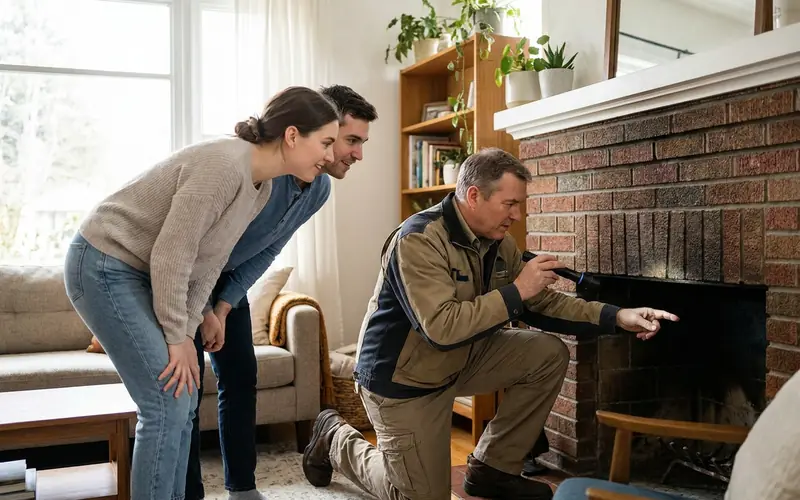
East Tennessee’s real estate market moves fast, and in a fast market the chimney is the classic blind spot. Here’s the situation every agent and honest inspector knows: general home inspections examine the firebox, not the flue. The inspector opens the damper, shines a light, checks for obvious cracking — and notes “recommend further evaluation by a chimney professional” on a system they can’t actually see into.
That recommendation is where deals go to die — or get saved. Here’s why the Level 2 camera inspection is worth its cost in every wood-burning home transaction, Knoxville to the Tri-Cities.
What a Level 2 Actually Adds
The camera pass records the entire flue interior — every tile, joint, and seam, top to bottom. On a real-estate timeline, it answers the three questions that matter:
- Is the liner intact? Cracked, shifted, or missing tiles are invisible from the living room and fatal to a wood-burning system’s usability.
- Is there hidden creosote? A flue coated in Stage 2–3 glaze is a fire waiting, and a chimney fire in your first winter in the house is a bad housewarming.
- Is the system usable at all? NFPA 211 requires this inspection level at every property transfer anyway — knowing before closing beats finding out after.
For Buyers: Negotiation Insurance
A Level 2 costs a few hundred dollars. What it regularly finds in our market’s housing stock:
- Failed liners in 1940s–60s homes (the Oak Ridge and Kingsport stock is arriving at liner end-of-life together)
- Creosote glaze in homes heated with wood — especially in Cocke County, Sevier County, and the mountain-adjacent areas where families burn long seasons
- Uncapped, unlined, or deteriorated chimneys in the region’s older historic districts
Any one of these is a significant repair. Found before closing, it’s a negotiation item with photos attached. Found after, it’s your repair bill. The math on the scan is not complicated.
For Sellers: A Clean Report Is a Selling Point
Sellers order the Level 2 for the opposite reason: a clean, camera-verified chimney removes a contingency and closes faster. A documented report with photos converts “recommend further evaluation” into “professionally verified” — and prevents the scenario every seller dreads: a last-minute chimney finding, renegotiated price, a delayed closing, and an inspection tag-along who doesn’t know chimneys.
It’s the same logic as pre-listing roof and HVAC documentation: verified systems sell houses smoother.
The Part Nobody Mentions: Insurance
Homeowners insurance claims involving chimney fires or water damage lean heavily on maintenance history. A documented, recent inspection — with photos, in writing — is the difference between “the system was professionally evaluated and sound” and “the flue’s condition was unknown.” Buyers inheriting a documented system start their ownership with that file; sellers leave one behind. That’s a real transfer of value.
How We Handle Real-Estate Deadlines
We run closing-deadline inspections all season:
- Fast scheduling — tell us your closing date; we prioritize accordingly
- Same-day written reports with photos in most cases — your agent, attorney, or lender gets what they need
- Honest findings, no drama — we don’t inflate findings to make a headline, and we don’t minimize them to keep a deal alive. Photos, findings, prioritized plan. The deal is your business; the truth is ours.
And if the report does find something — liner failure, glaze, water damage — you’ll get itemized, honest repair pricing you can take to the negotiation table: relining, rebuilds, or the specific repair the system needs. No vague “could be thousands” clouds.
Before You Sign Anything With a Chimney In It
A few hundred dollars for a camera pass. A few thousand dollars of typical findings caught on the right side of closing. That’s the whole pitch.
See what our Level 2 includes or call (865) 309-5432 with your closing date — we’ll make the schedule work.
